

Square Steel Bars
Square steel bar, which has a grainy texture and radius level corners, is a very robust and adaptable building material. Carbon steel square bar stock is one of the most often used industrial and construction materials in the world due to its durability, adaptability, and affordability. Square steel bar exists in the form of various shapes such as solid bars and hollow tubes.
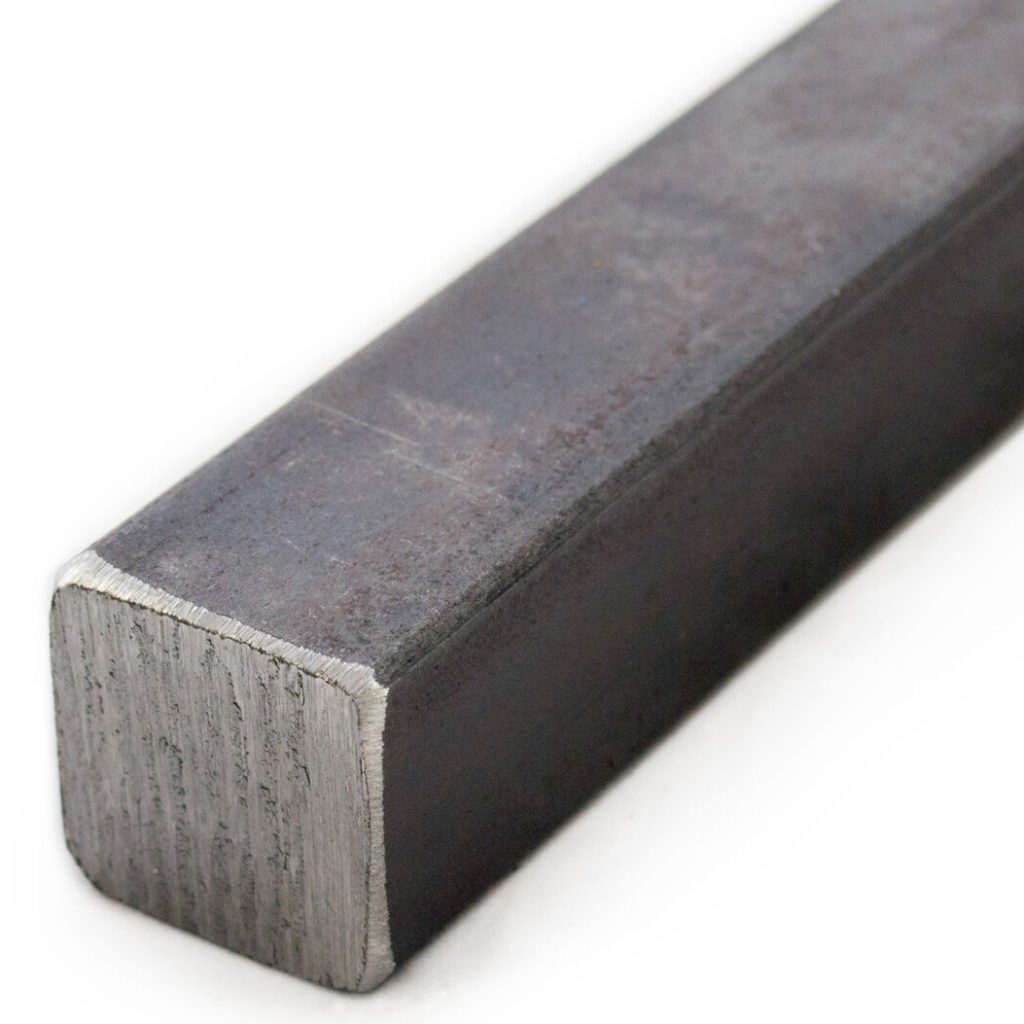
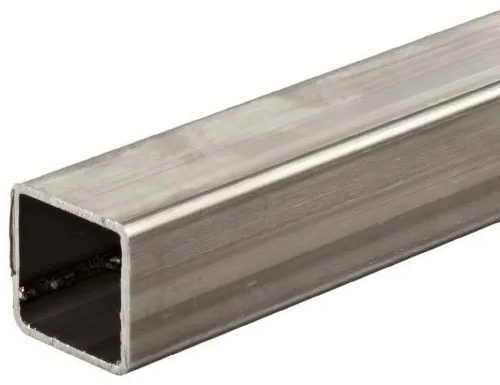
The material of square steel bars is usually mild steel. However, the specified steel grade and yield strength must be checked from the project documents and material certificate.
Square tubes and square steel pipes are used for a variety of civil engineering projects, including the construction of buildings and the assembly of various types of machinery in factories. They are also used in the welding of various pieces of equipment.
In this topic, we look at the method for calculation of weight of square steel bars: both the solid and hollow steel bars.
Quick Formulas for Square Steel Bar Weight
Solid square bar:
Weight per metre [kg/m] = 0.00785 × a2
Hollow square section:
Weight per metre [kg/m] = 0.00785 × [B2 – (B – 2t)2]
In these formulas, a is the side of a solid bar, B is the outside side of a hollow section, and t is the wall thickness. All dimensions are entered in millimetres. The formulas use a steel density of 7,850 kg/m3.
For more than one bar:
Total weight = weight per metre × bar length × number of bars

Square Steel Bar Weight Calculator
| Result | Value |
|---|---|
| Cross-sectional area | 2,500 mm2 |
| Weight per metre | 19.625 kg/m |
| Weight per foot | 13.187 lb/ft |
| Weight of one bar | 117.750 kg / 259.594 lb |
| Total weight | 117.750 kg / 259.594 lb |
Result for 1 bar(s), each 6 m long, using a density of 7,850 kg/m3. Hollow-section results use a sharp-corner approximation.
Data Required for Steel Weight Calculation
To calculate the weight of steel, we need two things:
- The mass density of steel
- The volume of steel
What is the Unit Weight of Steel?
The unit weight of a material is the weight per unit volume of the material. The mass density and unit weight of steel are commonly taken as approximately:
- Mass density = 7,850 kg/m3
- Unit weight = 77.0 kN/m3 when standard gravity is used
- Mass density = 490 lb/ft3
In normal quantity calculations, people usually call the result in kilograms the steel weight, although kilograms are technically a unit of mass.
What is the Volume of a Steel Bar?
The volume equals:
Volume = cross-sectional area × length
For a solid square bar, the area is equal to the side multiplied by the side. For a hollow square section, subtract the inside square area from the outside square area.
How to Calculate the Weight of Steel?
Steel weight calculation is done with the help of the steel weight formula.
The general formula is:
Weight of square bar = density × volume
Solid Square Steel Bar Example
Calculate the weight of a 50 mm square steel bar with a length of 1 metre.
Side length = 50 mm
Side length = 50 / 1,000 = 0.05 m
Cross-sectional area = side2 = 0.05 × 0.05 = 0.0025 m2
Volume = area × length = 0.0025 × 1 = 0.0025 m3
Weight = 7,850 × 0.0025 = 19.625 kg
This means that each 1 m of this square bar has a theoretical weight of 19.625 kg.
What if the length of the bar is more or less than 1 m?
The weight will be equal to the weight per metre multiplied by the total length.
If the length is 3.5 m:
Weight of the bar = 19.625 × 3.5 = 68.69 kg
Hollow Square Steel Bar Example
What differs in this case is the volume; specifically, the area will be changed.
Calculate the weight of a 50 mm hollow square steel section with a length of 1 metre and a wall thickness of 10 mm.
Outside side, B = 50 mm = 0.05 m
Wall thickness, t = 10 mm = 0.01 m
Area = B2 – (B – 2t)2
Area = 0.052 – (0.05 – 2 × 0.01)2 = 0.0016 m2
Weight = 7,850 × 0.0016 × 1 = 12.56 kg
This is a geometric estimate. Manufactured hollow structural sections have rounded corners and permitted dimensional tolerances. Therefore, use the mass listed by the manufacturer or the applicable section table for procurement and structural design.
Solid Square Steel Bar Weight Chart
| Side [mm] | Area [mm2] | Weight [kg/m] | Weight [lb/ft] |
|---|---|---|---|
| 10 | 100 | 0.785 | 0.528 |
| 12 | 144 | 1.130 | 0.760 |
| 16 | 256 | 2.010 | 1.350 |
| 20 | 400 | 3.140 | 2.110 |
| 25 | 625 | 4.906 | 3.297 |
| 30 | 900 | 7.065 | 4.747 |
| 40 | 1,600 | 12.560 | 8.440 |
| 50 | 2,500 | 19.625 | 13.188 |
| 75 | 5,625 | 44.156 | 29.674 |
| 100 | 10,000 | 78.500 | 52.750 |
Approximate Hollow Square Section Weight Chart
| Outside size [mm] | Wall [mm] | Calculated area [mm2] | Approx. weight [kg/m] |
|---|---|---|---|
| 25 × 25 | 2 | 184 | 1.444 |
| 30 × 30 | 2 | 224 | 1.758 |
| 40 × 40 | 2 | 304 | 2.386 |
| 40 × 40 | 3 | 444 | 3.485 |
| 50 × 50 | 3 | 564 | 4.427 |
| 60 × 60 | 3 | 684 | 5.369 |
| 75 × 75 | 4 | 1,136 | 8.918 |
| 100 × 100 | 5 | 1,900 | 14.915 |
The hollow-section chart uses the sharp-corner formula. It is useful for a quick estimate, but it is not a replacement for the manufacturer’s published mass or the applicable AISC section properties.
Difference Between a Solid Square Bar and Square HSS
| Item | Solid square bar | Square HSS |
|---|---|---|
| Section | Solid metal throughout | Hollow section with a specified wall thickness |
| Main dimensions | Side, a | Outside side, B, and wall thickness, t |
| Hand calculation | a2 × density | [B2 – (B – 2t)2] × density |
| Final purchasing value | Confirm the applicable product tolerance | Use the manufacturer’s or AISC section mass |
Important Note About Theoretical and Actual Weight
The calculator and the formulas provide theoretical mass. Actual mass can differ because of corner radii, dimensional tolerances, wall-thickness tolerances, coating, and the actual density of the steel grade. This difference is especially important for hollow structural sections.
AISC publishes dimensions and properties for standard HSS shapes. For ASTM A500 HSS, design calculations may use a design wall thickness that differs from the nominal wall thickness. Therefore, do not use the simplified sharp-corner area to replace the section properties required for structural design.
References
- AISC, Steel Construction Manual and current section-property resources
- AISC Shapes Database v16.0
- AISC HSS information and designation guidance
- Steel Tube Institute, ASTM A500 HSS guidance
- Segui, W. T., Steel Design, 6th Edition, Cengage.
Read Also: