

To calculate the weight of a rectangular steel bar, first find its cross-sectional area. Then, multiply that area by the bar length and the steel density. For ordinary carbon steel, a practical density is 7850 kg/m3 (about 490 lb/ft3).
Solid rectangular bar: mass per metre = B × H × 0.00785 kg/m
Rectangular hollow section: mass per metre = [B × H – (B – 2t)(H – 2t)] × 0.00785 kg/m
B = outside width, H = outside height, and t = uniform wall thickness. However, the RHS equation is a sharp-corner theoretical estimate.
Rectangular Steel Bars
In general, rectangular steel bar, which normally has a mill-finished texture and slightly rounded edges, is a very robust and adaptable building material.
As a result, carbon rectangular bars are among the most often used industrial and construction materials because of their durability, adaptability, and affordability. For example, these bars are used in construction equipment, steel structures, buildings, ships, power plants, agricultural and chemical machinery, curtain-wall framing, automobile chassis, and more.
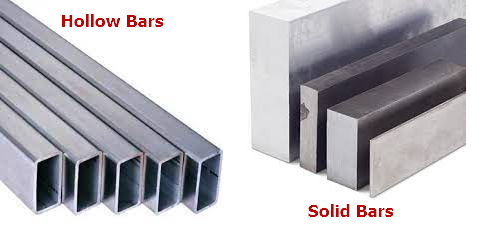
The material is often mild or structural carbon steel. However, although some mild-steel products have a yield strength near 250 MPa, the actual grade and strength must come from the product specification. In any case, yield strength does not change the weight formula; density and geometry do.
In practice, rectangular steel sections exist in solid form and hollow form. Here, we look at the method for calculation of weight of rectangular steel bars: both solid rectangular bars and rectangular hollow sections (RHS).

Rectangular Steel Bar Weight Calculator
First, choose solid or hollow, enter the dimensions, and use either SI or U.S. customary units. Also, the calculator updates automatically; the button performs the same calculation.
Solid and RHS calculator
Calculation: –
However, this is a theoretical geometry result. For manufactured RHS, compare it with the applicable standard or supplier’s published mass.
Data Required for Steel Weight Calculation
First, to calculate the weight of steel, we need two things:
- The volume of steel, found from cross-sectional area × length.
- The mass density of the specified steel.
Finally, if several identical pieces are required, multiply the mass of one piece by the quantity.
Steel Density and Unit Weight
Density is mass per unit volume. In contrast, unit weight is force per unit volume. Therefore, they are related, but they are not the same property.
- Mass density used here: 7850 kg/m3, approximately 490 lb/ft3 or 0.2836 lb/in3.
- Unit weight under standard gravity: about 77.0 kN/m3.
In ordinary estimating, people say “steel weight” even when the answer is stated in kg or lb. Strictly, the calculator gives mass. For force units, multiply mass in kilograms by gravitational acceleration to obtain weight in newtons.
Rectangular Steel Weight Formulas
| Section | Cross-sectional area | Mass per unit length | Input condition |
|---|---|---|---|
| Solid rectangle | A = B × H | m/L = A × ρ | B and H must be positive. |
| Sharp-corner RHS | A = B × H – (B – 2t)(H – 2t) A = 2t(B + H – 2t) |
m/L = A × ρ | t > 0, 2t < B, and 2t < H. |
Here, A is area, B is outside width, H is outside height, t is wall thickness, ρ is density, m is mass, and L is length. Therefore, use consistent units. For example, with dimensions in mm and density in kg/m3, multiply the area in mm2 by ρ × 10-6 to obtain kg/m.
Solid Rectangular Steel Bar
Since the bar is rectangular, the cross-sectional area equals the width multiplied by the height.
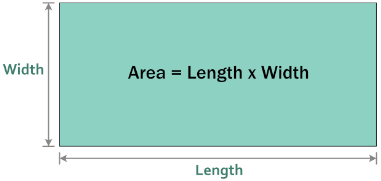
Solid rectangular bar example in SI units
For example, calculate the mass of a rectangular steel bar with side A = 50 mm, side B = 100 mm, and length = 1 m.
- First, convert the sides: 50 mm = 0.05 m and 100 mm = 0.10 m.
- Then, cross-sectional area = 0.05 × 0.10 = 0.005 m2.
- Next, volume for 1 m = 0.005 × 1 = 0.005 m3.
- Finally, mass = 7850 × 0.005 = 39.25 kg. Therefore, the linear mass is 39.25 kg/m.
What if the length is more or less than 1 m? In that case, the mass equals the mass per metre multiplied by the total length. For example, if the length is 3.5 m:
Mass = 39.25 × 3.5 = 137.375 kg.
Solid rectangular bar example in U.S. units
For a 4 in × 2 in solid steel bar:
Here, area = 4 × 2 = 8 in2. Then, using 490 lb/ft3, mass per foot = (8/144) × 490 = 27.22 lb/ft. Therefore, a 10 ft piece has a mass of about 272.22 lb.
Rectangular Hollow Section (RHS)
In comparison, what differs in this case is the volume; specifically, the steel area is the outside rectangle minus the empty inside area. For a constant wall thickness t, the inside dimensions are B – 2t and H – 2t.
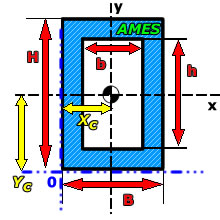
RHS example in SI units
For example, calculate the mass of a rectangular hollow steel section with outside dimensions 50 mm × 100 mm, wall thickness 10 mm, and length 1 m.
- First, inner dimensions = 50 – 2(10) = 30 mm and 100 – 2(10) = 80 mm.
- Then, steel area = 50 × 100 – 30 × 80 = 2600 mm2 = 0.0026 m2.
- Finally, mass = 7850 × 0.0026 × 1 = 20.41 kg. Therefore, the sharp-corner estimate is 20.41 kg/m.
RHS example in U.S. units
For a 4 in × 2 in rectangular tube with 0.25 in wall thickness, the inside dimensions are three and one-half inches by one and one-half inches.
Therefore, steel area = 4 × 2 – 3.5 × 1.5 = 2.75 in2. Then, using 490 lb/ft3, mass per foot = (2.75/144) × 490 = 9.36 lb/ft. As a result, a 10 ft piece is about 93.58 lb.
Real structural hollow sections have rounded corners, and welded products have a longitudinal seam. In addition, nominal dimensions and wall thickness have manufacturing tolerances. For quick estimating, the sharp-corner formula is useful. However, for purchasing, lifting plans, and structural calculations, use the mass and section properties in the applicable standard or the certified supplier data.
Common Calculation Mistakes
- Entering millimetres in a metre-based equation without the conversion factor.
- Using outside area alone for an RHS and forgetting to subtract the hollow area.
- Subtracting the wall thickness once instead of twice from each outside dimension.
- Calling 7850 kg/m3 a force unit; it is mass density.
- Treating a theoretical sharp-corner result as a certified catalogue mass.
- Adding paint, galvanizing, weld metal, end plates, bolts, or fittings without accounting for their separate mass.
References
- Steel Tube Institute: ASTM A500 structural tubing guidance.
- Steel Tube Institute: Dimensions and Section Properties of ASTM A500 HSS.
- Steel Construction Institute: Blue Book, SCI P363.
- NIST Special Publication 811: Guide for the Use of SI.