

Cement is a dry powder, usually grey in colour, prepared mainly from limestone and clay. Cement is a binder material. When water is added to cement, it hydrates and hardens. Mixing cement with water gives paste. Adding sand makes mortar. Adding sand and gravel makes concrete.
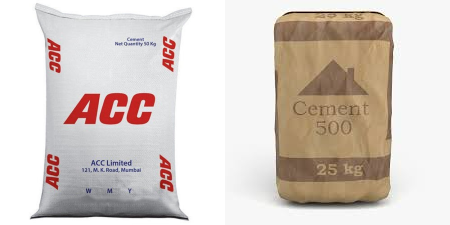
In many places, cement bags weigh 25 kg or 50 kg. This article shows the volume of both bags in cubic metres, cubic feet, and litres. You can use the same formula for any other bag weight.
Volume of 25 kg and 50 kg Cement Bags
| Bag weight | Volume in m3 | Volume in litres | Volume in cubic feet |
|---|---|---|---|
| 25 kg | 0.0174 m3 | 17.4 litres | 0.613 ft3 |
| 50 kg | 0.0347 m3 | 34.7 litres | 1.226 ft3 |
These values use an assumed loose bulk density of cement of 1,440 kg/m3. They are estimating values, because the loose bulk density can change with aeration, settlement, and handling.
Formula for the Volume of a Cement Bag
V = m / ρ
For the following calculations:
- Assumed loose bulk density of cement = 1,440 kg/m3
- 1 m3 = 1,000 litres
- 1 m3 = 35.3147 ft3
Cement Bag Volume Calculator
| Unit | Calculated volume |
|---|---|
| Cubic metres [m3] | 0.034722 |
| Litres [L] | 34.722 |
| Cubic feet [ft3] | 1.226 |
| Cubic yards [yd3] | 0.0454 |
| US gallons [gal] | 9.173 |
Result for 1 bag of 50 kg using a loose bulk density of 1,440 kg/m3.
How to Calculate Volume of 50 kg Cement Bag?
Depending on where you are, the weight of cement bags may differ. You can read here about the weight of cement bags in different countries.
Volume = 50 kg / 1,440 kg/m3 = 0.03472 m3
To convert the result to litres:
0.03472 x 1,000 = 34.72 litres
To convert the result to cubic feet:
0.03472 x 35.3147 = 1.226 ft3
Therefore, one 50 kg cement bag occupies approximately 0.0347 m3, 34.7 litres, or 1.226 cubic feet when a bulk density of 1,440 kg/m3 is used.
How to Calculate Volume of 25 kg Cement Bag?
Volume = 25 kg / 1,440 kg/m3 = 0.01736 m3
To convert the result to litres:
0.01736 x 1,000 = 17.36 litres
To convert the result to cubic feet:
0.01736 x 35.3147 = 0.613 ft3
Therefore, one 25 kg cement bag occupies approximately 0.0174 m3, 17.4 litres, or 0.613 cubic feet using the same assumed density.
Cement Bag Volume Chart
| Bag weight | Volume in m3 | Volume in litres | Volume in cubic feet |
|---|---|---|---|
| 20 kg | 0.0139 | 13.9 | 0.491 |
| 25 kg | 0.0174 | 17.4 | 0.613 |
| 40 kg | 0.0278 | 27.8 | 0.981 |
| 42.6 kg [94 lb] | 0.0296 | 29.6 | 1.045 |
| 50 kg | 0.0347 | 34.7 | 1.226 |
How Many Cement Bags Are in One Cubic Metre?
You can reverse the formula to estimate the number of bags in one cubic metre of loose cement.
- For 50 kg bags: 1 / 0.03472 = 28.8 bags per m3
- For 25 kg bags: 1 / 0.01736 = 57.6 bags per m3
These figures refer to the equivalent loose volume of cement powder. They do not mean that 28.8 bags will produce one cubic metre of finished concrete. Concrete also contains water, fine aggregate, coarse aggregate, and sometimes admixtures. The concrete yield depends on the approved mix design.
Loose Cement Volume Is Not the Physical Bag Size
The calculated volume is based on mass divided by an assumed loose bulk density. It is not a guaranteed external volume obtained by multiplying the length, width, and thickness of the sack. The package dimensions can change with the bag material, filling method, aeration, settlement, and stacking pressure.
Also, do not confuse a bag of cement with a bag of ready-mix concrete. Ready-mix concrete contains cement, sand, and aggregate, and the manufacturer normally states its wet yield after adding water.
References
- Technical and Vocational Education Training Manual, cement density and bag calculations
- Food and Agriculture Organization, concrete and cement volume guidance
Read Also: